
Defining the Work, Not Just Explaining It
What real clarity looks like in a requirements review.

Explaining vs defining the requirements can look the same in a requirements review, at least in the moment. Someone may restate the problem, a few edge cases come up, and the approach sounds reasonable. Nothing sounds off so everyone assumes they’re on the same page.
The difference shows up in what changes afterwards, and ideally during the review itself. The requirements are updated in the moment when real clarity is achieved. As that clarity comes through, the scope starts to tighten. Questions come up around dependencies, and it becomes clearer what constraints actually need to be written down.
In one case, the work is explained, the team agrees, and moves on with only a vague grasp of how the project will evolve. In the other, the requirements are rewritten before anyone leaves, grounding the execution in what will actually happen.
Not only that, but working through the requirements this way also gives teams a clear view into how the work will actually be carried out, or identify where handoffs or dependencies will explicitly need to occur. That visibility makes it easier to communicate across departments and builds trust in how the work is being handled.
One way to check is to walk through execution. Lay out the next steps, who owns what, and what depends on what. If that breaks down or stays vague, the requirements are not ready. This is usually where it becomes clear what is still missing.
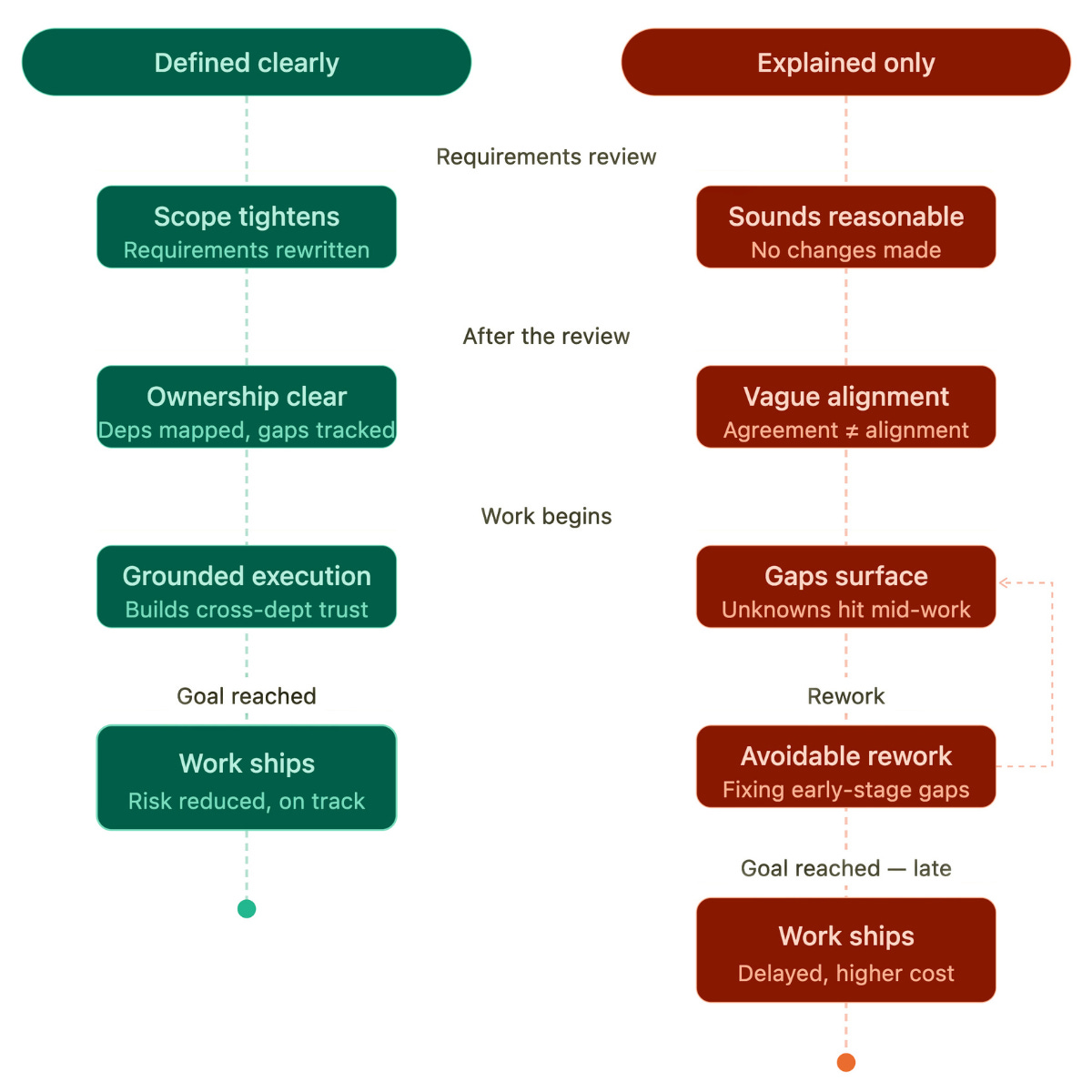
If the requirements do not change, that can indicate that a solid understanding of the work didn’t come across to the group. There may be agreements, but that doesn’t always indicate alignment.
That gap in understanding carries forward. Work starts on something that sounded right, then time is spent fixing what could have been worked through earlier.
Let’s take a quick step back and get some perspective.
It is not realistic to expect every review to reach a perfect state. Time is limited. Not everyone is always in the room. Some details only become clear during execution. You will not eliminate all rework.
What is realistic is catching the important gaps early, making meaningful changes to the requirements during or right after the review, and tracking what is still unresolved instead of assuming it is handled.
What matters most is whether the review reduces avoidable risk and forces the unknowns into the open. If it doesn’t, it may feel smooth, but that could mean there are gaps that haven’t been tested yet.
Work that is understood reflects real execution across dependencies and downstream impact. The level of rigor should scale with importance.
If something is worth doing, it is worth understanding. If not, it likely shouldn’t be prioritized.