
Are Precision Gates Slowing Your Team Down?
How misplaced data requirements stall work that's ready to move.

There’s a pattern that shows up quietly across product, operations, sales, and finance teams. It doesn’t announce itself. It looks like a process working exactly as designed. But underneath, it’s costing you time, momentum, and trust.
It goes like this: work is ready to move forward, but a system, a CRM, a project tool, a workflow platform, won’t allow it to. Not because the work is incomplete. Because a field isn’t filled in. And not just any field. A field that requires a level of precision nobody has yet, and nobody can reasonably have at this stage.
Call it a Precision Gate: a system-enforced requirement for exact data at a point in the workflow where directional data is all that exists, or all that’s needed. Directional data is information that signals relative magnitude or movement without claiming exactness, think Low, Medium, or High, a rough range, or a qualitative signal like “likely upsell” or “renewal risk.” It tells you which way things are heading, even when the exact destination isn’t yet clear.
Why It Happens
Precision Gates are usually built with good intentions. Someone, at some point, needed accurate data downstream, in a forecast, a report, a handoff, and worked backwards to enforce it earlier in the process. The logic feels sound: if we require it now, we’ll have it when we need it.
The problem is that this thinking collapses two distinct moments into one. The moment when directional information is available, and the moment when precise information is actually required. When a system can’t distinguish between those two moments, it treats every earlier stage as a blocker rather than a stepping stone.
There’s also an accountability dimension worth naming. Systems are often designed with data integrity in mind, and requiring a field early feels like a way to protect that integrity. What this can miss is how people respond when they’re asked for precision they don’t yet have. The instinct to keep things moving doesn’t disappear, it finds a workaround. And the more concerning workaround isn’t leaving a field blank. A blank field is visible. It stops work and signals a gap. The deeper risk is when someone enters an estimate they aren’t confident in, or a number that looks plausible but isn’t grounded in anything real, just to clear the gate and move forward. Bad data flowing silently downstream is a significantly worse outcome than a visible stall. It shapes forecasts, informs decisions, and often isn’t caught until the damage is done.
It’s More Common Than You’d Think
If you’re wondering whether this is really a widespread pattern, consider how many of these feel familiar:
A recruiter can’t advance a candidate without a salary expectation entered, before comp has ever been discussed. A project tool blocks a task from “In Progress” until every subtask has estimated hours, on the first day of planning. A procurement system requires a final vendor selection before a budget request can be submitted, even though the budget is needed to evaluate vendors. A sales CRM won’t move an opportunity to “Proposal Sent” without a close date, even when the timeline is genuinely unknown.
In these examples, the gate is always in the wrong place.
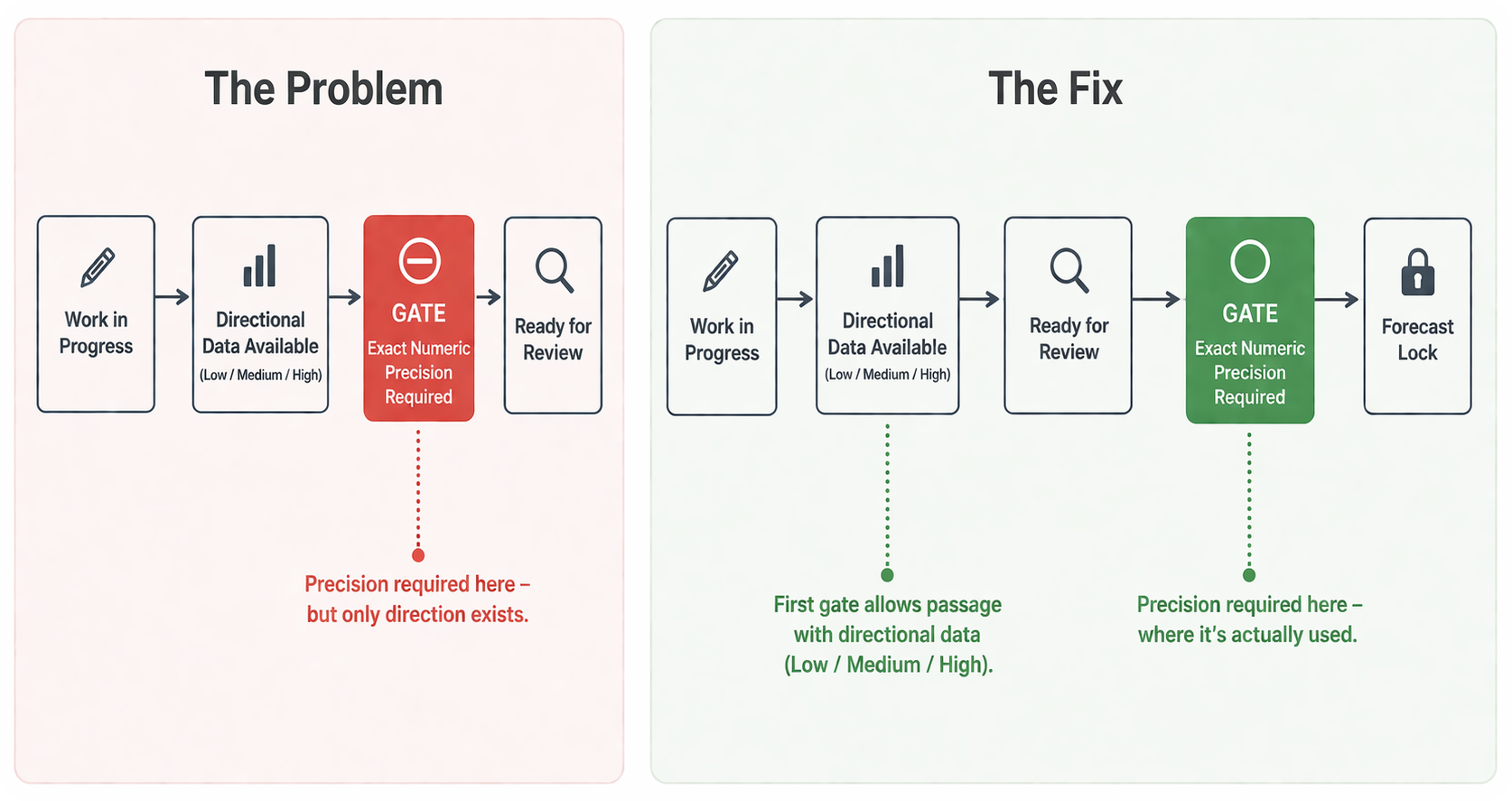
A Closer Look
Consider a product ops team managing a Quarterly Expansion Plan in a CRM. Each account has a required field, Projected Expansion Value, that feeds a leadership revenue dashboard. CS managers are supposed to populate it after completing their quarterly account reviews.
Most reviews get done. The field stays empty. The plan can’t advance to “Ready for Review.”
The instinct is to assume managers don’t have the data. The real issue: managers had plenty of directional signal, notes like “likely upsell” or “renewal risk,” but no way to enter it without committing to an exact number they weren’t ready to stand behind. The system asked for precision. They had direction. So they left it blank and moved on.
The fix wasn’t better data. It was a better gate. Two fields replaced one: an Expansion Signal (Low, Medium, High) and an optional Estimated Value. The plan could advance once the signal was captured. Finance still required the numeric value, but at forecast lock, where it actually belonged.
Accounts moved out of Draft within two days. No loss in forecast accuracy. Significant reduction in cycle time.
The Fair Objection
The reasonable pushback here is: if you make precision optional early, it never gets captured at all. That’s a legitimate concern, and it’s exactly why the solution isn’t to remove precision requirements, it’s to move them. A downstream checkpoint, owned by the right team at the right stage, enforces exactness where it’s actually used. Directional data flows freely. Precise data gets locked in when locking makes sense.
The gate doesn’t disappear. It just gets placed correctly.
What To Do With This
If your team is regularly waiting on information before work can move forward, it’s worth asking whether the wait is real or manufactured. Some questions to start:
What information does the system require that the team doesn’t actually have at this stage? Where does that information actually become available? And is the downstream consumer of that data truly blocked without it, or just accustomed to requiring it early?
You may find that the blocker isn’t a data problem. It’s a gate problem. And gates, unlike data, are entirely within your control to redesign.
TheRootSystem explores the decisions behind how product and operations teams actually work, the systems, the trade-offs, and the patterns worth naming.